This headline caught my eye this morning, “Mexico Fights Discarded Gum Problem By Telling People to Swallow It”.
Some interesting things in the article are:
- The average square yard of Mexico City sidewalk has 70 blobs of discarded chew.
- Mexico is responding with innovations ranging from expensive sidewalk steam-cleaners to natural chewing gum that breaks down quickly.
- Modern chewing gum was born in the 1860s when Mexican Gen. Antonio Lopez de Santa Anna brought some Mexican chicle to U.S. inventor Thomas Adams, who first experimented with it as a possible rubber substitute but later added flavorings and sold it as a treat.
- Mexicans chew an average of 2.6 pounds of gum each year.
- That is half of what Americans chew.
- The Mayans chewed unflavored chicle to clean their teeth.
- Singapore once famously banned chewing gum outright to save its sidewalks, and still requires chewers to register at the pharmacy.
(Source: Fox News); (Image by: 7-how-7 on flickr)

I got this email on Friday from Krispy Kreme in Mexico. It really goes to prove the differences in how Americans think about time and how Mexicans think about time.
The purpose of the email was to promote their “new” Christmas doughnuts. However, they sent the email the day after Christmas, and these doughnut styles have been in the stores for weeks now.
Latin American cultures do not think about time like we think about time in the United States. They are not time oriented, nor do they plan very far in advance. I’m generalizing here, but I have observed that, in Mexico, people are much more important than events.
The person who sent this email was probably busy with Christmas parties with friends and didn’t get around to sending the Merry Christmas email until after Christmas.
Either that, or they are really early for next year.

We traveled 30 hours over the course of 3 days this week to get to Florida to spend time with our family for Christmas. That’s right, we DROVE our car from Mexico City to the Tampa Bay Area. We did it with 2 little kids, too.
Are we crazy? Probably. But the question that I have been asking myself is “Where is home?” Something weird happens to you when you live for a while outside of your homeland. You start to wonder where your home really is.
Someone once said that home is where your heart is. But what do you do when your heart is in two different places?
One of our missionary friends tells the story of his son who was called out of the audience when they went to an amusement park in Nicaragua. When they asked him where he was from, he said, “I’m from here”, even though everyone in the audience knew that he wasn’t born in Nicaragua. But to him, he was “from” there. Sometimes, I feel the same way.
So, where is home for us? Our house is in Mexico. Our family is in Florida. Our job is in Mexico. Many of our friends live in Florida. I honestly don’t know where home is. It’s confusing.
I guess it shouldn’t be that confusing, though. Our citizenship is in heaven (Philippians 3:20). This world is not our home. Our home is not in Florida or in Mexico.
But sometimes it’s hard to explain that. So, “going home” for me is always going to the location that is different than where I am at the time. Next week, we’ll be “going home” to Mexico. Last week, we were “going home” to Florida. Are you confused yet? We are.
Anyone else ever felt that way?
Today is the day that Mexicans commemorate the day in which the Virgin of Guadalupe appeared to Juan Diego. Many people make pilgrimages to the Basilica and there are various celebrations. They say to be Mexican is to be Guadalupano (or a follower of Guadalupe).
 I wrote a paper called, “The Early Foundations of Mariology” for one of my seminary classes. You can download it here (PDF). It talks about Mary in early church history.
I’ve also visited the Basilica many times. Each time I’m there, I take a some pictures. Here are some pictures I’ve taken, uploaded to Flickr and tagged with Guadalupe.
I’ve read and written many things about the Virgin of Guadalupe. Here are some previous posts I’ve written about this day:
Resources about the Virgin of Guadalupe

Some of my best memories as a youth pastor in Dunedin, Florida, were going to a monthly youth worker meeting. I would sit in the youth room at Clearwater Community Church and talk shop with a bunch of like minded people. Every month it would be a little different, but I remember looking forward to this meeting, unlike many other meetings I had to go to in those days.
Leadership can be lonely. Often times, you go about your business, and it seems like nobody even notices what you do (unless it’s bad) or even the struggles that you have in your own personal life. Most of the time, ministry is difficult. But because we recognize the need that leaders have to connect with each other, we held the first ever youth leaders’ network meeting in northwest Mexico City.
I don’t know about you, but I always feel great after hanging out with people who share the same vision I do (like we did when we went to Ecuador). Networking is more than just seeing what you can get from other people or even how you can work together to extend your reach.
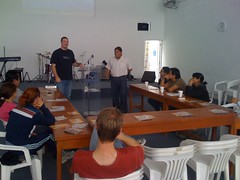 It’s about a shared vision and a shared passion. It’s about shared dreams. It is about identifying with other people so that you can understand that you’re not alone in ministry (and so they understand this, too). This type of connection is vital.
Yes, leadership is lonely, but we are doing what we can to encourage those youth workers in our area and let them know that what they do is important.
What can you do to help connect other like-minded people? You need it as much as they do.