A recent article in USA Today tells about Mexican youth subcultures and the troubles that have been happening between them lately.
“A spate of attacks by punks and other groups on the emos has thrown a spotlight on the rapid growth of these “urban tribes” of disaffected, tech-savvy teens and young adults.”
Emos, punks, goths, and other subcultures have all emerged in the last few years, and there is tension between them at times.
“The divisions among young people turned violent in March, when Internet posts and cellphone messages began appearing urging darks, punketos (punk rockers) and other groups to chase the emos from their hangout on the main plaza in the city of Querétaro.”
On March 7, hundreds of teens rushed the emos in the plaza, beating three of them. Television footage showed an emo pinned against a wall while the mob chanted, “He wants to cry! He wants to cry!” Police arrested 28 people.
A week later, riot police were called after punk rockers hurled bottles at a pro-emo protest at the Insurgentes Traffic Circle, an emo hangout in Mexico City. The tension subsided after a group of Hare Krishnas marched through the traffic circle, apparently unaware of what was going on.
I believe these subcultures will continue to grow in the future, and if the church continues doing what it is doing, we will never even think about the needs of these various groups.
Unfortunately, these different subcultures are not even being taken into consideration by the majority of the church. I am praying that God will raise up a generation of youth workers who have the passion and knowledge to be able to reach out to these young people. I hope I get to be a part of the generation of leaders who makes a difference in the lives of these young people.
Yesterday in my Professional Orientation to youth ministry class, we talked about contacting students in ministry. We talked about many different ways to contact people, and in class, I asked on twitter for some suggestions on how to contact students during the week.
Of course, the popular way to contact students in the United States right now is on Facebook. I received replies from both Tony and Sara that told me to suggest creating Facebook groups to keep in touch with students. Right now, Facebook has not really caught on in Mexico.
However, Huberto showed me a social network that is taking off in Mexico. It’s called Hi5, and it’s really pretty much like all the other social networking sites that are out there right now. Hi5 is the 3rd largest social networking site in Latin America and has more users than MySpace or Facebook.
It looks a lot like MySpace, in my opinion. Huberto says he uses it to stay in touch with the students in his ministry, and he was worried about the dangers that there are with his students using these sites and putting too much information online, etc.
I thought that this whole conversation was good because it’s interesting to see how different countries’ use of social media evolves. I started a Spanish social network on ning.com for youth workers, which led the youth pastor from our church to create one for the youth ministry at our church.
Social networking is getting more popular in Mexico, and it will definitely be a way to communicate with young people in the future. Right now, it’s cutting edge. I wonder what new thing will be out in the USA when it finally becomes mainstream here?
Missionaries (and youth workers) are constantly studying culture to be able to effectively communicate and minister. We’ve studied a lot of culture throughout our time here in Mexico. So, if you’re interested in Mexican youth culture and Mexican culture in general, be sure to check out The Research Lab.
In the lab, you can download our research on Mexico. Maybe you’ll learn something. If you’re a missionary in Mexico, we hope it helps you understand the culture better. We’re not experts, but we have learned some things.
We’ll be adding more to the Lab as we continue to research and investigate youth culture in Mexico. You can also check out all of our posts in the culture category.
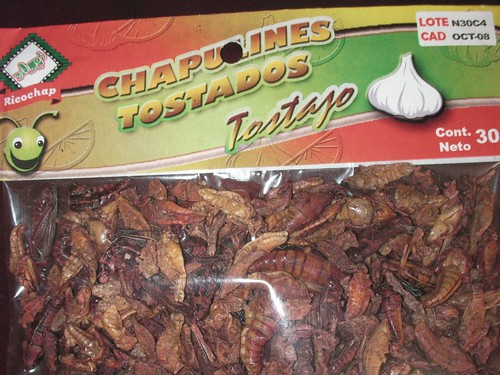
My students came to class today with a snack. They are chapulines tostados, known in English as toasted grasshoppers.
I didn’t have it in me to try them yet, but if I ever do, you know I’ll video it because it’s more than likely that I won’t eat them more than once (even though my students suggest I’ll like them).
They come toasted, with salt, lime, and garlic on them. They can also be eaten with salsa on them (like on popcorn). I’m seeing the beginnings of a cool youth group game…maybe “Chubby Chapuline” or “Fear Factor.”
I was explaining the idea of April fool’s day to my students in class today, and they told me about Mexican April Fool’s Day, which falls on December 28, and is called “Día de los Inocentes” or “Día de los Santos Inocentes.” The name means Day of the Innocent Ones or Day of the Innocent Saints.
On this day in Mexico (December 28), you are not to lend anyone money because they will just take it, and you are considered the fool. They also play pranks on each other like Americans do on April 1. Also, the newspapers and media outlets publish stories that are not true, just like the do in the United States.
If someone falls for your prank on The Day of Innocent Ones, you sing the following song, “Inocente palomita que te dejaste engañar, porque sabes que en este día, a nadie debes confiar.”
The translation is, “You let them fool you, you innocent dove. You know that today you shouldn’t trust anyone.”
We use cookies on our website to give you the most relevant experience by remembering your preferences and repeat visits. By clicking “Accept”, you consent to the use of ALL the cookies.
This website uses cookies to improve your experience while you navigate through the website. Out of these, the cookies that are categorized as necessary are stored on your browser as they are essential for the working of basic functionalities of the website. We also use third-party cookies that help us analyze and understand how you use this website. These cookies will be stored in your browser only with your consent. You also have the option to opt-out of these cookies. But opting out of some of these cookies may affect your browsing experience.
Necessary cookies are absolutely essential for the website to function properly. This category only includes cookies that ensures basic functionalities and security features of the website. These cookies do not store any personal information.
Any cookies that may not be particularly necessary for the website to function and is used specifically to collect user personal data via analytics, ads, other embedded contents are termed as non-necessary cookies. It is mandatory to procure user consent prior to running these cookies on your website.