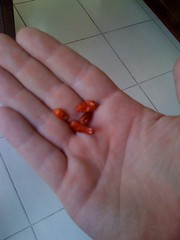
 The chile piquin is a small but powerful type of chile pepper. I tried one the other day because my students had told me that they would make an excellent illustration for my sermon on the tongue. They were right. I had to spit it out because I didn’t want it to burn my esophagus.
Today I preached on James 3 at Bethel Church in Xochimilco. My introduction was the chile piquin. We talked about three observations about the tongue: It has power (for good or evil); it is difficult to tame; and controlling it is essential to living out our faith.
It’s a lot easier to preach about taming the tongue than it is to live it. I think part of it has to do with the fact that there are so many ways to slip up with the tongue. It takes only a little moment in time to lose your temper and say something that you will regret for a long time.
I had a good time with a new group of Christians today, and I pray that the sermon will take root in their lives and the life of their church.

Today I saw this sign at the seafood section of Walmart, which reminds us all that it is Friday in Lent, a day for Catholics to abstain from meat.
Abstinence from all meat is to be observed by all Roman Catholics 14 years old and older on Ash Wednesday and on all Fridays of Lent.
According to Catholic teaching, abstinence is a form of penance. Penance “expresses sorrow and contrition for wrongdoing, indicates intention to turn away from sin and turn back to God, and makes reparation for sins. It helps to cancel the debt and pay the penalties incurred by transgressions.”
This picture, taken in Walmart, reminds me of how Catholic this country is. Please pray that all of the religiosity in Mexico will not blind people to seeing that the only payment for our sins took place on the cross and that there is nothing we can do to pay for our own sins.

I often wonder what the relationship should be like between Seminary professors and their students. There are certainly different kinds of leadership, and I believe that leadership, personality, and teaching styles all have to do with the kind of relationship a professor would have with his or her students.
There are some professors who are close to being seen as drill-sergeants. What they say goes and there is no bending of the rules. What has been forcefully agreed upon in the syllabus is a contract, unless of course they (the professor) choose to change the rules of that contract.
There are other professors who don’t take attendance and are very buddy-buddy with their students. An assignment turned in sometime during the term is not a late assignment. Tests and quizzes are rarely used, and when they are, they are hardly graded. Students might like this professor, but secretly they are disappointed because they are not learning anything.
There are also professors who have gained respect of their students but haven’t forced the respect like a drill sergeant. They are respected for what they have accomplished and for the type of relationships they cultivate with their students. They know when to be buddies and they know when to enforce the rules.
I can think of various professors in my past who have fit into one of these three categories. I learned from each of them in different ways. Now that I’m on the other side of the classroom (as the professor), I have to think of which type of professor I want to be.
Which kind (or others) of professor did you learn the most from?
(Photo by: Jaredchapman on flickr)

This week is the week of intensive courses at our Seminary. Dr. Karen Jones from Huntington University is teaching the youth ministry course called “Foundations of Youth Ministry.”
She is focusing on lesson plans and teaching/learning styles. It’s great to have her here with us.
There are lots of things I love about having professors visit Mexico and interact with my students.
Here are a few of them:
- The students get to know (and learn from) someone else besides me, who has different experiences and a different teaching style.
- The students have the chance to learn from experts in various subjects.
- The students have the opportunity to expand their network of contacts in the youth ministry world.
- Other professors get to be involved in Global Youth Ministry and can see what is happening in youth ministry in Mexico.
- The visiting professors have a better grasp on how to pray for our ministry.
- I have time to work on other projects (like our diploma in youth ministry program).
- I get to know and network personally with other youth ministry professors.
If you’re in youth ministry, have you ever thought about visiting a foreign country and sharing what you have learned in ministry with youth workers overseas? Youth Ministry International would love to be in contact with you and see how you can contribute to global youth ministry training. Contact us.

Earlier today, I tweeted (and consequently updated my Facebook status),
“4 of the greatest words in the English language – ‘Daddy, I love you’.”
Nathan had just said it to me, and then I got to thinking about that phrase in another way.
Imagine how us expressing our love to God makes Him feel. If I can feel so good hearing Nathan tell me that He loves me, my worship must make God feel great.
Crawling up next to our Heavenly Father and telling Him, “Daddy, I love you,” has to be a great feeling for Him. Especially if we don’t do it out of obligation or to see what “special favor” He will do for us. When we say that phrase as a genuine expression of our love for Him, it is true worship.