Wednesday in my Professional Orientation to Youth Ministry class, one of the students came in with a very heavy heart. He had spent the whole day before with one of the students in his ministry. My student was talking about the situation, and I could feel his heart for the guy in his youth group.
Much of what we teach in seminary is theory. There is a lot of information that passes between professor and student, but something that you can’t really teach in a classroom is what my student demonstrated yesterday in class. The compassion and burden for people is something that cannot be learned in the classroom. It is something that God gives you. When you hurt for those who are hurting, you are demonstrating a true characteristic of Christ.

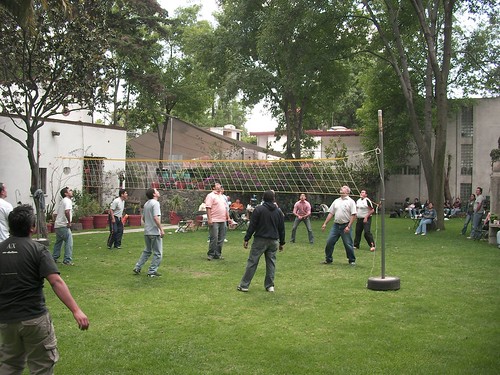
Twice a year, the seminary has a retreat that is obligatory for all students. In the past they have been very programmed, and, quite frankly, they tire me out. Going away for an all day adventure with the entire seminary sounds like lots of fun, but it’s always ended with me having a headache and being so worn out that I can’t be ready for the next day’s classes.
However, our retreat last week was fun and tiring, and I’ve decided that there are many benefits to these retreats on a personal level.
- The Youth Ministry program is more visible.
- My attendance is a good example for my students.
- I can get to know the director and dean better.
- I get to know more students who aren’t in my classes.
- There’s usually pretty good food.
Here are some pics from the retreat:




Click an image to view a larger version.
Today, I started teaching Youth and Family Ministry to my first year students at the Mexican Baptist Theological Seminary. There are a few basic theological principles behind the class, and none is more important than the mandate that God gave Israel in Deuteronomy 6:4-9.
The Shema (click here to hear it sung), as it is known, is one of the most important Jewish prayers. It declares that there is one God, and then it goes on to talk about 3 responsibilities.
- Personal Responsibility: Each person is to love God with all their heart, soul, and strength. It is a personal responsibility to have this command on our hearts. We cannot fulfill the other two responsibilities without first fulfilling this one.
- Family Responsibility: We are to “impress” it on our children. It is the responsibility of the parents to teach their children about God. Interestingly enough, the responsibility does not fall on the church (although I believe the church helps the parents with their responsibility).
- Social Responsibility: Writing them on the gates of the city is about the responsibility we have to share with the community about God.
I believe these responsibilities are in the order they are in for a reason. We cannot expect our children to love God if we do not love him. We cannot “preach” to the community if our families are not examples of loving God. There’s a lot more to be said, but it’s the basis of Youth and Family Ministry. We had a good discussion about this in class this morning.

Middle school is a period of most of our lives that we would love to forget. Our legs and arms grow too big for our bodies; our voices sound like we swallowed a frog, we begin to notice how bad we smell, and many other embarrassing things. Middle school is a self-esteem nightmare. The irony of middle school is we are happy when finally we “graduate” and become freshmen in high school.
Unfortunately, seminaries are not too much different than middle schools. They are full of academic competition, intellectual arguments, and ministry comparisons. A person with low self-esteem will probably not last more than a week in either a seminary or a middle school.
Even the faculty members at seminaries have problems with this. The degree that you have, and where you earned it, play into our competitive nature, causing us to intimidate others or be intimidated by others.
Shouldn’t the opposite be true? Shouldn’t seminaries be places to encourage and engage people in a loving manner without judging their intellectual ability or their ministry competency? Instead of chewing people up and spitting them out, shouldn’t we be “spurring one another on to love and good deeds?”
I’d love to see my seminary as a place where people feel welcomed and are seen as part of the same team, regardless of if they are studying theology, youth ministry, music, or Christian education. I’d love to see the professors that have been around forever and have their Ph.D look at the others as equals and respect them as experts in their field with something valuable to contribute to the school. I’d also love to see the new professors be less intimidated by the others, and it would be great if we weren’t all always trying to impress each other. We are, after all, part of the same body.