What is big enough to shut down the two largest religions in Mexico: Soccer and the Catholic Church? Mass has been canceled in Mexico City’s National Cathedral on Sunday, soccer games were played without the usual crowds of thousands in closed and empty stadiums.
The Secretary of Education canceled class in Mexico City, the Federal District, and San Luis Potosi for more than a week. The Mexican government’s treasury department has even allocated almost half a billion dollars to fight it.
What could be big enough to cause this mayhem? The answer: Swine Flu.
What is Swine Flu?
Swine Flu is the talk of the town in one of the world’s largest metropolitan areas. It is a weird strain of the flu whose “combination of genes had not been seen before in flu viruses in humans or pigs.” You can’t get it from eating pork. But it is dangerous. So far there have been more than 1300 cases of it in Mexico with more than 80 deaths. You can read more about swine flu at the CDC website.
Is it safe to travel to Mexico?
The CDC website says, “CDC has NOT recommended that people avoid travel to Mexico at this time.” In fact, there have been no swine flu cases reported in Mexico’s beach resorts, which are hundreds of miles away from Mexico City.
While it’s not recommended to visit Mexico City right now, most of Mexico is not (yet) affected. That doesn’t mean you shouldn’t be cautious when deciding to visit Mexico or not.
How to protect yourself from Swine Flu
Inside Mexico has a great post on how to protect yourself from Swine Flu, which includes some no brainers, such as washing your hands, avoiding hospitals unless absolutely necessary, and limiting physical contact.
The Mexican government has also put out a bulletin with recommendations on how to protect yourself from swine flu.
How does Swine Flu affect the Poulette Family?
The Seminary has canceled class until May 6th. Our church has suspended all activity this weekend as well. We had already planned to go out of town, so it’s not going to affect us too much. We are taking the same precautions as everyone else, which is just basically avoiding a lot of contact with other people and washing our hands like crazy.
Many of the Seminary students travel all over the city and country for their weekend work at various churches, so they might be affected. Pray for this sickness and the country of Mexico right now. It doesn’t look like it’s going away anytime soon.
Swine flu is something that we will be wondering about for a while. Please keep praying for our family here in Mexico.

Many people are worried about our safety. Many people have asked if it’s safe to visit Mexico. Some people have even encouraged us to leave Mexico because of what they have seen on the news. Is Mexico as dangerous as the news channels have made it out to be?
Regardless of where you live, danger exists. Every country and every city have their own unique problems and dangers. I’m not going to write a lot about the issue of safety in Mexico, but here are a few things I’ve seen on the web lately about safety in Mexico:
Is Mexico Safe?
We’re confident that the place we live is safe. We are thankful for those people who worry about us. But, we have work to do, and we know that we are in the safest place we can be right now.

I just read these statistics from a survey done by Reforma, a local newspaper here in Mexico City, about what Mexicans think of President Barack Obama.
Two out of three Mexicans have a favorable opinion of the President of the United States, Barack Obama.
When asked, “What is your opinion of the President of the United States?”, 65% responded “very good” or “good”.
Thirteen percent said “okay.” Seven percent said “bad” or “really bad”, and 15% responded, “I don’t know.”
In the same study, 66% of the people interviewed consider that the relationship between Mexico and the United States is “very good/good”. Fifteen percent said “normal”, a 14% said “bad/very bad”. Five percent did not respond to the question.
(The survey was conducted March 28th by telephone to 850 respondents from all over Mexico and has a margin of error of +/- 3%)
Source (in Spanish)
Image by: Steve Rhodes on flickr

Many Christians bemoan the cultural expressions of Christianity, or the cultural alternatives to Christian holidays. The Easter bunny takes center stage, and the passion and resurrection of Jesus is sometimes seen as an afterthought.
Easter bonnets, new dresses, a ham feast with family, and other things are all part of our cultural heritage. They were all part of how I grew to celebrate Easter as a child (within the context of a Christian family). Living in Mexico has allowed me to see a little of how another culture has shaped the holiday.
In Mexico, there is no Easter bunny. Easter candy has been creeping onto shelves, but is for the most part uncommon. I often am questioned about the origin of Easter eggs and the Easter bunny. In our experience, the cultural celebration of Easter has taken a very traditional religious form.
Good Friday is celebrated much more than Resurrection Sunday. As I blogged about before, Mexico is the home to the largest passion play in the world. Even the evangelical churches have little celebration on Sunday, opting instead for special Good Friday services where the topic of the sermon is almost always the last words of Christ on the cross.
The Baptist Church we attend had a sunrise service Sunday at 6 am, but the other services were “normal.” If you don’t attend the sunrise service, there is very little mention of the fact that it is even Resurrection Sunday. There is no sign of “dressing up”; no little girls in Easter bonnets or new frilly Easter dresses. Easter Sunday is just another day, while Good Friday is the cause of religious celebration.
This is the cultural expression of the holiday that we have here in Mexico. While it doesn’t take the form of bunnies and candy, it does affect the worldview of the people to whom we (and our students) are ministering.
We hope you had a great Easter season. We hope that you can live everyday celebrating the triumph of Christ over the grave. We hope that the celebration of Resurrection Sunday will continue to be a daily reality in your life.
Check out Janell’s thoughts on Easter in Mexico here (Our Easter Plans).
(Image by: JolieNY on flickr)
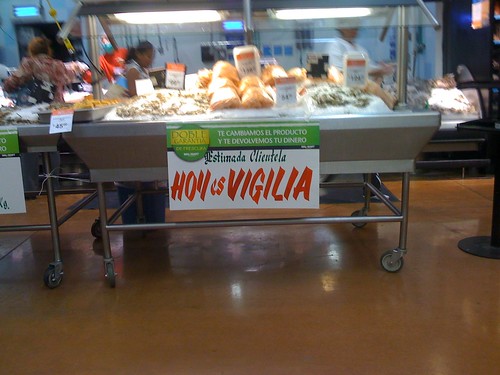
Today I saw this sign at the seafood section of Walmart, which reminds us all that it is Friday in Lent, a day for Catholics to abstain from meat.
Abstinence from all meat is to be observed by all Roman Catholics 14 years old and older on Ash Wednesday and on all Fridays of Lent.
According to Catholic teaching, abstinence is a form of penance. Penance “expresses sorrow and contrition for wrongdoing, indicates intention to turn away from sin and turn back to God, and makes reparation for sins. It helps to cancel the debt and pay the penalties incurred by transgressions.”
This picture, taken in Walmart, reminds me of how Catholic this country is. Please pray that all of the religiosity in Mexico will not blind people to seeing that the only payment for our sins took place on the cross and that there is nothing we can do to pay for our own sins.

One of the great things about living in another country is that we get to eat authentic Mexican food anytime we want. In fact, it’s something you miss when you go back to your homeland for a while.
It’s always great to get back to enjoying some great Mexican food. We love our favorite Mexican foods and have written about them before.
But I got to thinking about some Mexican foods to avoid, so I created a list of five foods to avoid in Mexico.
- Pancita – cow belly. Sometimes the word “delicious” is used to describe it. I’m not sure you can use the word delicious to describe the taste of stomach.
- Mole – a mixture of hundreds of ingredients (there are different kinds of mole…I think I might like some of them, but most of the time, I don’t like it.)
- Sesos – Brains that also come in tacos. I wonder if eating them makes you smarter?
- Tacos de cabeza – Head tacos, with that great “head smell”.
- Machito – lungs, heart, etc, of a baby goat
I know that these dishes probably taste pretty good to some people, but if you’re just visiting Mexico and have a short time here, you might want to avoid them so you can enjoy your visit.
Oh, and don’t look for them on taco bell’s menu anytime soon.
(image by: Boeke on flickr)