I’ve been thinking a lot lately about Mexico City. For some reason, I can’t get it out of my head. There is an enormous need in this mega-city. Our job is to train youth workers for local churches. In the United States, there is a trained youth worker for every 600 young people. In the rest of the world, there is a trained youth worker for every 400,000 young people.
In order for Mexico City to have one youth worker for every 600 young people, there would have to be around 25,000 youth workers in this city. There aren’t even that many evangelical churches in Mexico City. The population of Mexico City is less than 2% Christian, and the young people of this country are in desperate need for role models, mentors, heroes, and leaders.
We’re off to a great start with the 9 students studying at the seminary to be youth ministers, but we need more workers. I believe that something great is going to happen in this city. We need youth ministers here in Mexico, and we need global youth workers from the United States who will help with this enormous job.

In Mexico, Epiphany is celebrated on January 6, and it is called “El Dia de Los Tres Reyes,” or “Three Kings Day.” It is the day when the three wise men from the east arrived looking for baby Jesus. The tradition has even given names to the three kings: Melchor, Gaspar, and Balthazar, and they arrived on horse, camel, and elephant.
I’m sure there are many ways of celebrating this day, but here are some of the things I have seen and learned in my time in Mexico. You can get your pictures taken with the three kings like you would get your picture taken with Santa Claus. The children write a note to the three kings asking for a gift (remember, they originally brought gifts to baby Jesus), and they send it off tied to a helium balloon. Then, the kings bring the gift for the children on the Three Kings Day.
Another tradition behind Three Kings Day is the Rosca de Reyes, which is a sweet bread that has a plastic baby Jesus inside of it. Each person cuts their piece of bread, and the one who finds the baby Jesus must have a party on the 2nd of February.
Photos by: Bookish in North Park via Flickr and SpacePotato
I saw this over at Amy’s blog, and I thought it was pretty funny, especially if you know a little Spanish.
‘Twas the night before Christmas y por toda la casa,
Not a creature was stirring-Caramba! Que pasa?
Los ninos were tucked away in their camas,
Some in long underwear, some in pijamas,
While hanging the medias with mucho ciudado
In hopes that old Santa would feel obligado
To bring all children, both buenos y malos,
A nice batch of dulces y otros regalos.
Outside in the yard there arose such a grito
That I jumped to my pies like a frightened cabrito.
I ran to the window and looked out afuera,
And who in the world do you think that it era?
Saint Nick in a sleigh and a big red sombrero
Came dashing along like a crazy bombero.
And pulling his sleigh instead of venados
Were eight little burros approaching volados.
I watched as they came and this quaint little hombre
Was shouting and whistling and calling by nombre:
“Ay Pancho, ay Pepe, ay Cuco, ay Berto,
Ay Chato, ay Chopo, Macuco, y Nieto!”
Then standing erect with his hands on his pecho
He flew to the top of our very own techo.
With his round little belly like a bowl of jalea,
He struggled to squeeze down our old chiminea,
Then huffing and puffing at last in our sala,
With soot smeared all over his real suit de gala,
He filled all the medias with lovely regalos-
For none of the niños had been very malos.
Then chuckling aloud, seeming muy contento,
He turned like a flash and was gone como viento.
And I heard him exclaim, and this is verdad,
Merry Christmas to all, y Feliz Navidad!
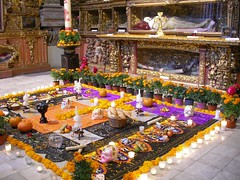 When I went downtown to observe the Day of the Dead celebrations, I was extremely interested in the beliefs of the Roman Catholic Church with respect to the celebration. I wondered if they would be participating in the celebration. The picture to the left is an altar set up in the Cathedral downtown. I was very interested to see it, and it looked exactly like the other “ofrendas” that were outside (see my video of the celebration).
November 1 and 2nd are catholic holidays. All Saint’s Day and All Souls’ Day are celebrated on those two days, and the date of the current Day of the Dead celebrations has a lot to with the catholic church. Some sources say that before the Spaniards arrived in the 1500s, the celebration of the Dead was the whole month of August, not the first two days of November. So, it can be said that the timing of the modern celebration is another result of syncretism between ancient religious beliefs and church beliefs of the 1500s.
 The fact that the Day of the Dead coincides with the All Saints’ Day and All Souls’ Day is no accident. It seems that the beliefs are a mixture of catholic traditions and indigenous practices. The belief in Mictlan, the place of the dead, comes from before the Spaniards arrived, as does Mictlantecuhtli, the god of hell and death. These beliefs and many others were mixed with the beliefs of the Spaniards, and what we have today seems to be a continuation of this mixture.
I’m by no means an expert on this subject, but I am continuing to observe and identify the culture to better understand the worldview of those with whom I am working. A person’s concept of death has a lot to do with their beliefs about God and religion. It’s good to research and try to understand these things, as it helps us to better form what we believe about the same things.
Sources: Day of the Dead – Wikipedia; Encarta; All Saints’ Day
Related: Festival of Colour, Mockery, and Family; Cottrill’s pics; My flickr set
Like I told you already, I went downtown on Friday to see the annual Day of the Dead celebration in the Zocalo. The day(s) of the dead are celebrated on October 31 until November 2. Here’s a translation of what the program they were handing out said:
The sacred ancient Mexican space of Mictlan refers to the mythical place where all individuals, when they die from natural causes, had to pass through dangerous places that, for four years, tested their intelligence and values that they learned in their lifetime.
For those from Mesoamerica, arriving at Mictlan was a mandatory path, a place of purification, in order to transition to other states of being. And one of the main doors to enter Mictlan was found close to Templo Mayor, with the present day Zocalo as its heart.
My thoughts on the celebration are many. A few things that I noted were the many people talking about how much the Day of the Dead is a Mexican holiday, and that it should be celebrated, and Halloween should not be celebrated, which echoes what I read about the Catholic church of Mexico’s comments earlier in the week. There were also many politically charged “ofrendas,” or traditional altars.
There is always some sort of protest going on downtown, and Friday was no exception, as we watched hundreds of people protesting naked in one corner of the main plaza.
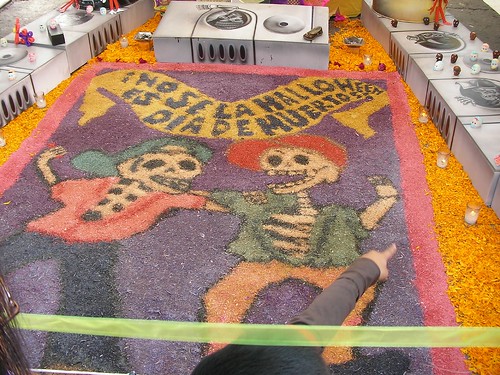
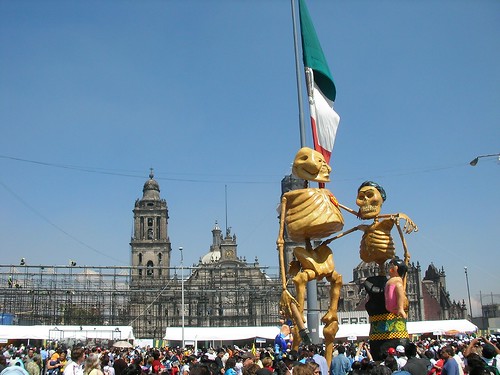
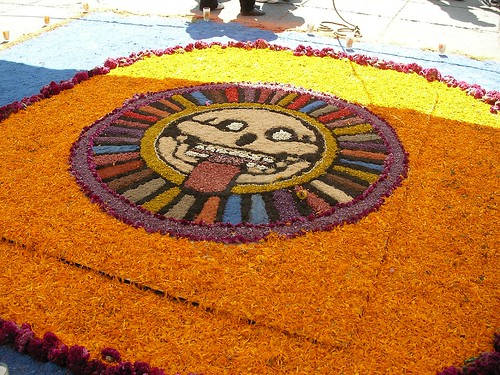
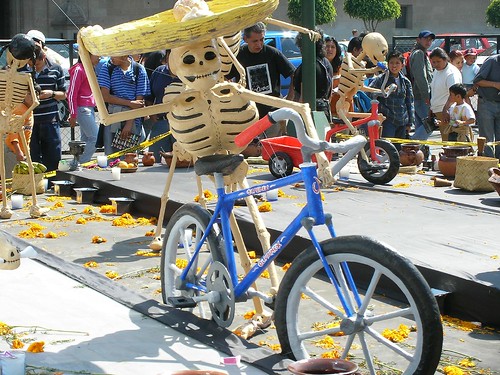
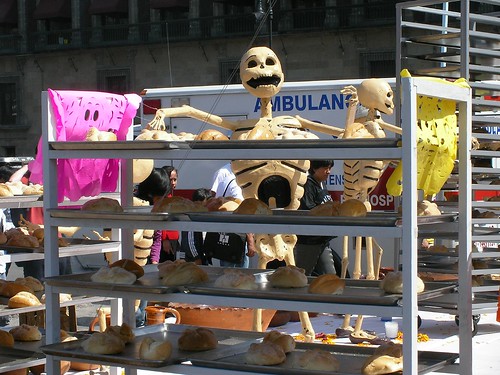
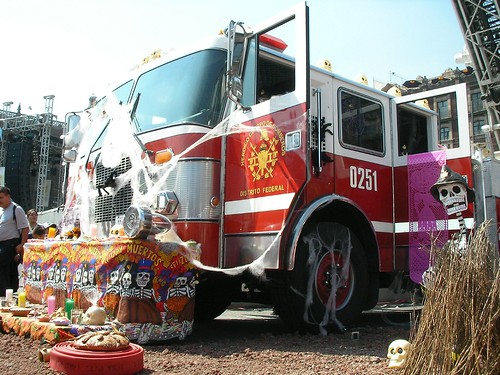
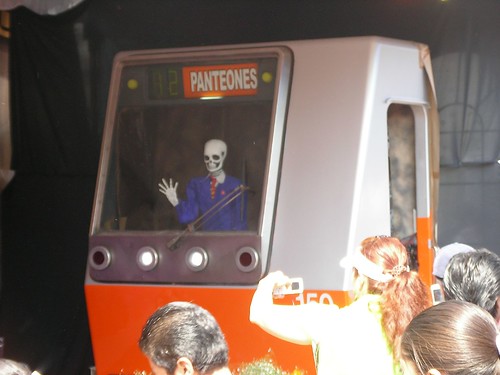
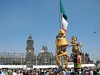
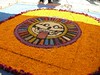
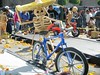
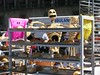
As for the celebration, it has almost gotten to a point of art. The “ofrendas” were elaborate, and the displays, artistically speaking, were incredible. I could tell that hours of work had gone into creating them. The celebration was attended by thousands of people. It was the largest cultural event I had been to since coming to Mexico.
I have more thoughts on the Day of the Dead, but I feel it warrants another post, so I’ll finish this post with some pictures from the festival downtown.

Click a thumbnail to see larger version
If you want to see the whole set on Flickr, click here.
I posted a video from the event here.
 In case you haven’t heard, there has been lots of flooding in the State of Tabasco, affecting hundreds of thousands of Mexicans.
They say 70% of Villahermosa, the capital city, is under water. All sorts of places have been set up where people can donate water and food for those affected.
We visited Tabasco about a year and a half ago, and it is a beautiful state. Our prayers are with the people who are affected.
Foto by: Jami Dwyer